Piers & Underpinning
House Leveling & Foundation Piers in Ridgecrest
When part of a home is sinking, piers can transfer its weight to firmer ground. Get connected with an independent, licensed contractor to see whether piers fit your situation.
- Push piers and helical piers
- Settlement stabilization and lift
- Free referral, no obligation
Free referral service · No obligation
Foundation Repair Ridgecrest is a free referral service, not a contractor. We do not perform foundation repair work. We connect property owners with independent, licensed foundation repair contractors, who may pay us for referrals. How it works
Get Connected With a Foundation Repair Pro
Tell us what you are seeing. We will match you with an independent, licensed contractor serving your area.
Prefer to talk? Call (760) 371-8564
When a Home Needs Piers
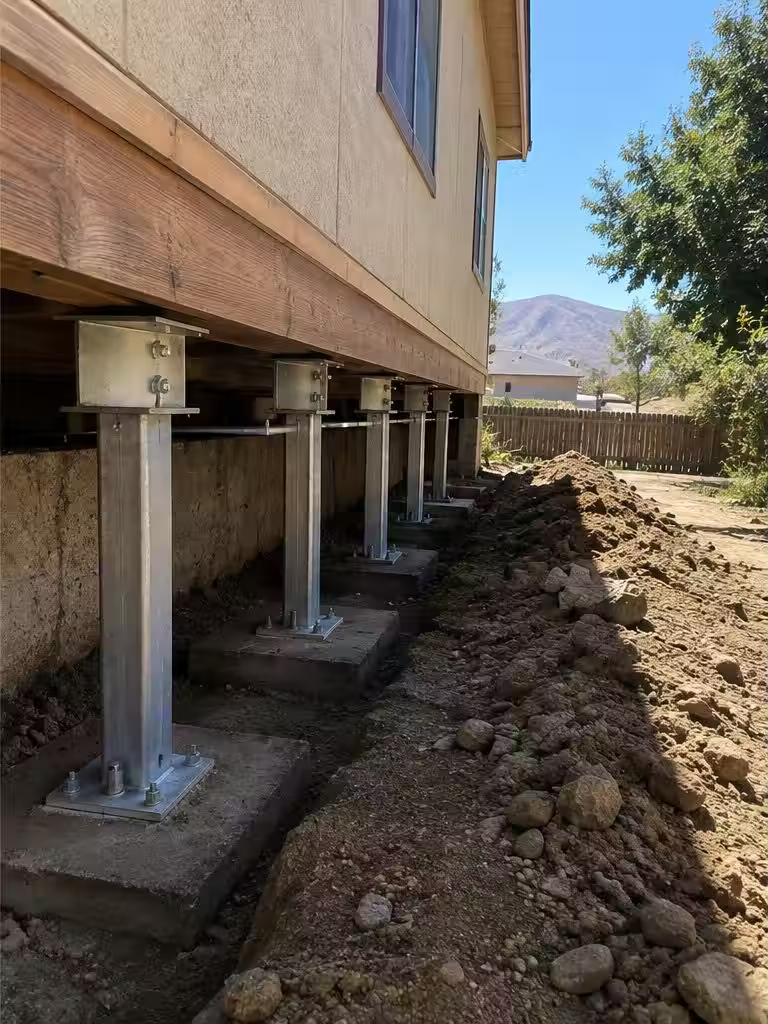
Piers are steel shafts driven or screwed down past weak soil to a firmer layer, then attached to the foundation with brackets. They stop further settlement and can sometimes lift the settled section back toward level. They are used when a corner, wall, or section of a home is sinking because the soil beneath it compacted or washed out.
In the Indian Wells Valley, settlement often follows water: a long-running leak or poor drainage that compacts loose sandy soil under one part of the slab. Piers address the support problem, but the water source needs fixing too, or the soil around the new piers keeps changing.
Signs Settlement May Need Piers
Several of these together, concentrated on one side of the house, point toward settlement.
Stair-step cracks
Diagonal, stepped cracks in block or brick walls that are widening.
Doors out of square
Tapered gaps at the top of doors on one side of the home.
Sloping floors toward one corner
A consistent slope that a level confirms, not just one soft spot.
Separation at the slab edge
Gaps between the slab and walls, porches, or garage floors.
What Do Foundation Piers Cost?
Published cost guides put piers at roughly $1,000 to $3,000 each, and some guides go to $3,500 for deep or difficult installs. Most projects need several, often 6 to 12 or more, so total cost depends heavily on how much of the home is settling.
These are typical ranges, not quotes. The number and spacing of piers comes from a contractor, and sometimes an engineer, after inspecting the home.
| Work | Typical range | Notes |
|---|---|---|
| Push or helical pier | $1,000–$3,000 each | Depth to firm soil drives cost |
| Typical foundation repair project | $2,200–$8,100 | Average about $5,200; pier jobs often more |
Typical ranges from published national cost guides, not quotes. Your price comes only from a contractor who has seen the property.
What affects the price
- Number of piers and their spacing
- Depth to load-bearing soil
- Interior vs. exterior installation
- Whether lift is attempted
- Engineering, permits, and drainage work
Is Part of Your Home Settling?
Tell us what you are seeing and we will connect you with an independent, licensed foundation pier contractor. Free, no obligation.
How Our Referral Service Works
We connect you with a contractor. The contractor does the work.
Tell us what you need
Call or send the form with what you are seeing and where the property is.
We match you
We pass your request to independent, licensed contractors who serve your area.
Talk to the contractor
The contractor contacts you, inspects the property, and gives you their own estimate.
You decide
Hiring is entirely your choice. Your agreement is with the contractor, not with us.
House Leveling & Foundation Piers Across the Ridgecrest area
We connect property owners with independent house leveling & foundation piers contractors in these communities. Choose your town for local details.
- House Leveling & Foundation Piers in Ridgecrest, CA
- House Leveling & Foundation Piers in China Lake Acres, CA
- House Leveling & Foundation Piers in Inyokern, CA
- House Leveling & Foundation Piers in Trona, CA
- House Leveling & Foundation Piers in Randsburg, CA
- House Leveling & Foundation Piers in California City, CA
- House Leveling & Foundation Piers in Mojave, CA
- House Leveling & Foundation Piers in Tehachapi, CA
Questions to Ask About a Pier Quote
How many, and where?
The quote should list the number of piers, their locations, and the target depth or load.
Push or helical, and why?
Both work. Ask why the contractor chose one for your soil and home weight.
What about the water?
Ask whether drainage or a leak is causing the settlement and how it will be addressed.
House Leveling & Foundation Piers FAQs
What is the difference between push piers and helical piers?
Push piers are steel tubes driven down using the weight of the house as resistance, which suits heavier structures. Helical piers have screw-like plates and are turned into the ground, which suits lighter structures. Both reach firmer soil below the weak layer.
Can piers lift my house back to level?
Sometimes. Piers can often recover part of the settlement, but lifting too far can crack finishes or plumbing. Contractors usually aim to stabilize first and lift only as far as is safe.
Do I need an engineer for pier work?
Not always, but larger pier projects often need an engineered plan and a permit. Ask the contractor and your local building department.
Get Connected With a Foundation Pier Contractor
Tell us about your property and we will connect you with an independent, licensed contractor in the Ridgecrest area. Our service is free.
- We review your request
- We pass it to up to 3 independent, licensed contractors serving your area
- A contractor contacts you to discuss your property
- Any inspection, estimate, and work are between you and the contractor
Most requests are passed to a contractor within one business day.